
Tankless Water Heater Flushing & Maintenance in Midlothian
A tankless unit needs less attention than a tank, but it isn't maintenance-free. The main job is flushing, also called descaling, to clear the mineral scale that builds up inside. How often depends mostly on whether your Midlothian home is on Chesterfield County water or a private well.
Why scale matters more in a tankless unit
Water passes through narrow passages in a tankless unit's heat exchanger and gets hot fast. Heat makes dissolved minerals drop out of the water and stick to the inside. Over time the coating cuts flow, makes the unit work harder, and can trigger maintenance or overheating codes. Flushing circulates a descaling solution through the heat exchanger to dissolve it.
Chesterfield County water
Most of Midlothian is on public water from Chesterfield County Utilities. The county describes it as naturally soft, in the range of 40 to 70 parts per million, or 2.0 to 4.0 grains per gallon. It comes from three sources:
- Swift Creek Reservoir, the lake at the center of Brandermill and Woodlake
- Lake Chesdin, through the Appomattox River Water Authority
- The James River, through the City of Richmond
Soft water means scale builds slowly, so many homes on county water get by with the manufacturer's standard schedule. Slowly isn't never, though. The county updates its water quality report each May, if you want the current figures.
On a private well
Some homes in western Chesterfield are on private wells, and well water around here can be much harder than county water and may carry iron or manganese. Harder water means more frequent flushing, and iron can foul the inlet filter. Get the water tested before deciding on a schedule or a treatment system.
One affordable route is the well water testing clinic that the Chesterfield County Extension office has run through Virginia Tech's Virginia Household Water Quality Program. Its test covers hardness, iron and manganese, along with bacteria and other items. Check with the Extension office for the next clinic date.
If the test shows hard water, ask your contractor whether a water softener or a scale-reduction system makes sense ahead of the tankless unit, and what the manufacturer says about it.
How often to flush
Your owner's manual sets the schedule for your model, and many recommend a flush at least once a year. Some units show a reminder or a code when they detect scale. As a rule of thumb:
| Your water | What to plan on |
|---|---|
| Chesterfield County water | The manufacturer's standard schedule. Soft water slows scale but doesn't stop it. |
| A well with hard water | More often than the standard schedule, or a softener or scale-reduction system ahead of the unit. |
| A well with iron | Check and clean the inlet filter more often, and ask about iron treatment. |
| Not sure | Test the water, or ask the contractor to look at the inside of the inlet filter and the unit's error history at the next visit. |
What a service visit should include
- A flush of the heat exchanger through the service valves, using a solution the manufacturer allows.
- Cleaning the water inlet filter screen.
- A look at the vent and air intake, inside and at the outside wall or roof.
- On condensing units, a check that the condensate drain runs freely, and fresh neutralizer media if it's due.
- A check for leaks at the gas and water connections.
- A look at the unit's stored error codes, if it keeps a history.
No service valves?
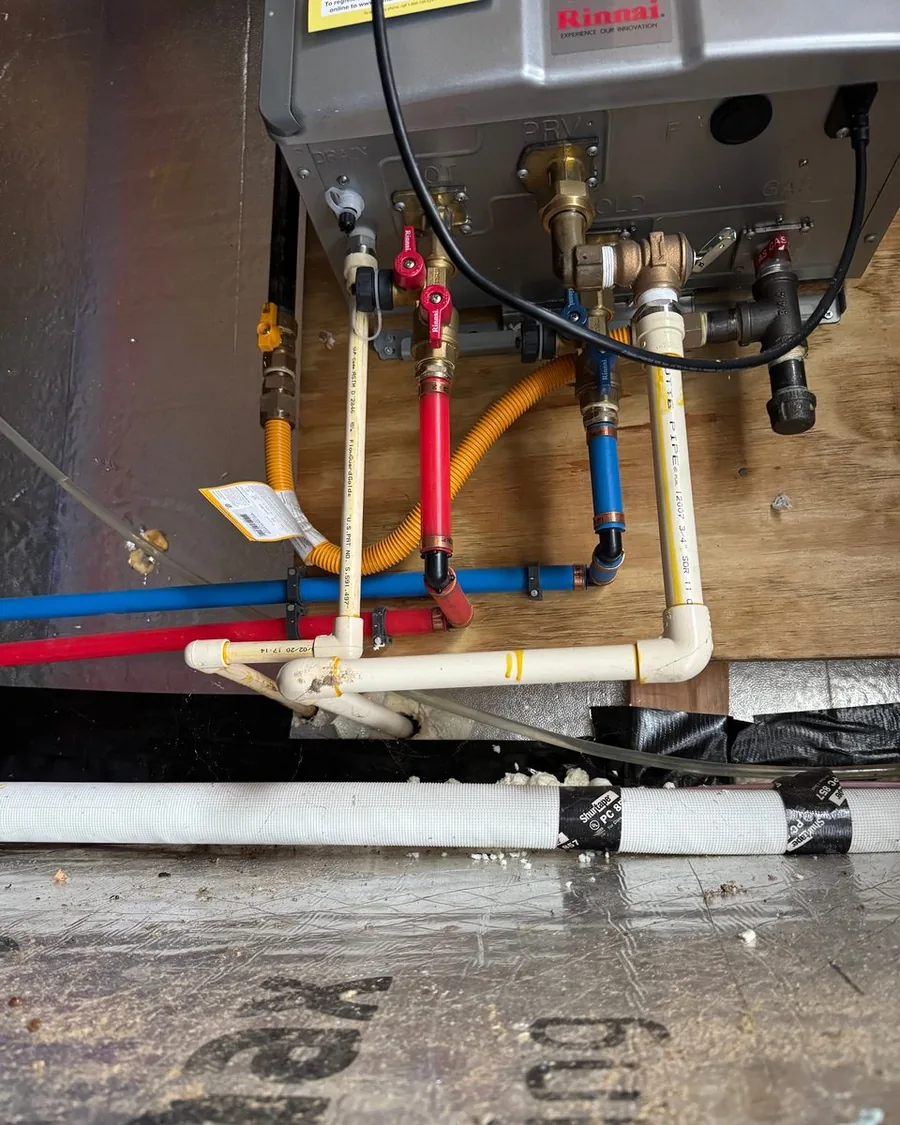
A flush connects through a pair of service valves on the hot and cold lines at the unit. Some older installations skipped them. A contractor can usually add them, and it's worth doing before the first flush, since every flush after that gets quicker and cheaper.
Doing it yourself
Plenty of homeowners flush their own units with a small pump, two hoses and a bucket. If you'd like to, follow your model's manual exactly. In outline:
- Cut power to the unit, close the water service valves, and shut the gas if the manual says to.
- Hook the pump and hoses to the service ports, with the pump sitting in the descaling solution.
- Open the ports and run the solution through the unit for as long as the manual says.
- Flush with clean water, then pull and rinse the inlet filter.
- Close the ports, open the service valves, restore gas and power, and check for drips.
Use only a solution your manual allows. Some allow plain white vinegar, others specify a descaler. If the flow doesn't come back after a flush, or codes keep returning, have a contractor take a look. Common problems and repairs.
Between flushes
- Keep the outside vent and air intake clear of leaves, mulch, shrubs, snow and nests.
- Glance at the floor under the unit now and then for drips.
- On a condensing unit, make sure the condensate line hasn't been kinked or knocked loose.
- Keep a simple record of each flush. Some warranties expect proof of maintenance.
Maintenance questions
Does soft county water mean I can skip flushing?
No. It means scale builds more slowly. Stick to the manufacturer's schedule unless your contractor sees a reason to change it.
What if my unit has been years without a flush?
Have it flushed and the inlet filter cleaned. Heavy scale may take more than one round. If flow and temperature don't recover, the heat exchanger may be damaged, and a contractor can tell you whether it's worth repairing.
Do condensing units need anything extra?
Yes. Their condensate is mildly acidic, so the drain and any neutralizer need checking, and the neutralizer media gets replaced on the manufacturer's schedule.
Can flushing void my warranty?
Done the way the manual describes, it shouldn't. Skipping it is the bigger risk, since scale damage is excluded under many warranties. Keep receipts or a log.
Talk to a tankless contractor in Midlothian
Call or send a short request, and it goes to one independent local contractor. The referral costs you nothing.