
Tankless Water Heater Repair in Midlothian, VA
No hot water this morning? A shower that goes lukewarm halfway through, or a number blinking on the front of the unit? Here are the problems tankless water heaters in Midlothian homes run into most, the few checks that are safe to make yourself, and the point where a repair stops making sense.
Smell gas? Don't touch the unit, light switches or the thermostat. Leave the house, then call your gas company's emergency line or 911 from outside.
What you're seeing, and what usually causes it
| Symptom | Common causes |
|---|---|
| No hot water at all | No power to the unit, a closed gas valve, an empty propane tank, a failed igniter or flame sensor, or a blocked vent or air intake that makes the unit shut itself down. |
| Hot, then cold, then hot | Often the normal short burst of cool water when a tap is shut and quickly reopened. If it happens all through a shower, look at gas supply, scale or a flow sensor. |
| Never gets hot enough | Too many fixtures at once for the unit's size, especially in winter when the incoming water is colder. Scale, a low gas supply or a failing mixing valve somewhere in the house can do it too. |
| Shuts off mid-shower | Flow dropping below the unit's minimum, often from a clogged inlet filter or a low-flow fixture. Overheating from scale, or the gas starving when the furnace and the unit fire together. |
| Weak hot water flow | Scale in the heat exchanger, a clogged inlet filter, or a partly closed service valve after the last flush. |
| A code on the display | The unit's own diagnosis. The code means different things on different brands, so look it up in your owner's manual or on the maker's site before anything else. |
| Water under the unit | A leaking fitting or valve, a blocked or disconnected condensate line on a condensing unit, or a leak inside. Turn the water off at the unit and call. |
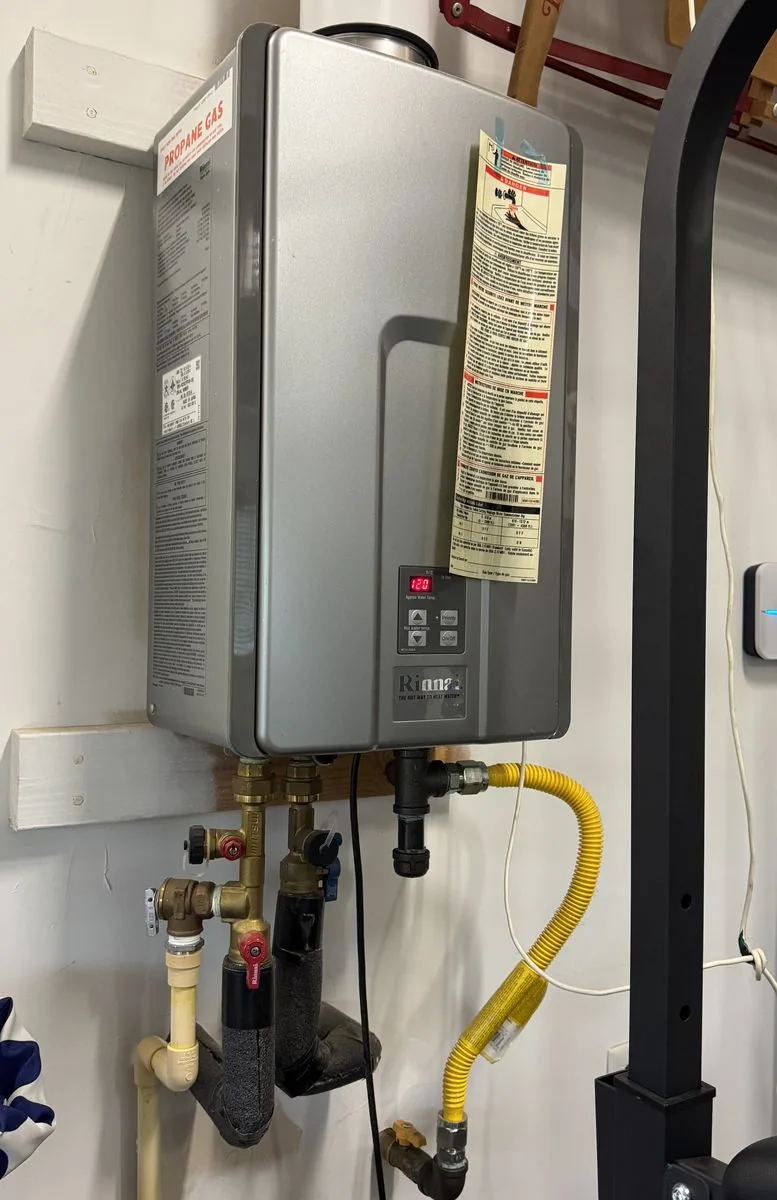
Checks that are safe to make yourself
These take a few minutes and solve a surprising share of no-hot-water calls. Don't take the cover off the unit or work on anything gas-related.
- Write down the code. If the display shows one, note it before you do anything else, then look it up in the owner's manual.
- Check the power. Look for a tripped breaker, or a tripped outlet if the unit plugs into one with a test button.
- Check the gas. Is the yellow-handled valve on the gas line to the unit open, in line with the pipe? Are your other gas appliances working? On propane, check the tank gauge.
- Check the valves. After a flush, a service valve left partly closed is a common cause of weak flow.
- Look at the vent outside. Leaves, a wasp nest, snow or a bush grown over the pipe can make the unit shut down.
- Restart it the way the manual says. Many units clear a code after power is switched off and back on. If the same code comes back, stop and call.
The causes behind most service calls
Scale
Minerals in the water coat the inside of the heat exchanger over time. Flow drops, the unit can run hot, and many models eventually throw a scale or maintenance code. Chesterfield County's public water is soft, so scale builds slowly on county water, but it still builds, and it builds faster on a hard well. Flushing is the fix, and regular flushing is the prevention. See flushing and maintenance.
Gas supply
A tankless unit needs a lot of gas at once. If the line from the meter is too small, or the meter can't keep up, the unit may light fine on a summer afternoon and fail on a winter morning when the furnace is running too. Propane units can have the same trouble when the tank is low or the regulator is undersized.
Venting and air
Units watch their own exhaust. A blocked termination outside, a crushed or disconnected vent pipe, or a vent run longer than the manual allows will make the unit shut down to protect itself.
Freezing
Units in unheated garages, crawlspaces or outside rely on built-in freeze protection, which needs power. A long outage during a hard freeze can crack a heat exchanger. Ask about draining the unit if you'll lose power in freezing weather.
Plumbing elsewhere in the house
Not every hot water problem is the heater. A single-handle shower valve or a faucet with a failing cartridge can let cold water cross into the hot lines, which looks like a weak heater from the shower.
Repair or replace?
The Department of Energy says most tankless units last more than 20 years, so a unit that's only a few years old is usually worth repairing. Repairing is usually the better call when:
- The problem is a part such as a sensor, igniter, fan or valve, and the part is still available.
- The unit is still under warranty. Find your registration and the install date before you call.
Replacing starts to make more sense when the heat exchanger itself leaks, when parts for an older model are hard to find, or when repairs keep stacking up. If the original installation was the problem, for example an undersized gas line or a vent that breaks the manual's rules, fix that as part of any replacement or the new unit will have the same trouble. What a proper installation includes.
Warranty terms vary by brand, and many don't cover damage from scale, freezing or an installation that doesn't follow the manual. Keep a record of each flush and service visit.
Repair questions
Why does my tankless unit work in summer but struggle in winter?
Incoming water is colder in winter, so the unit has to add more heat for the same shower, and the furnace is competing for gas at the same time. If it's undersized for winter or short on gas, that's when it shows.
Is it safe to reset a tankless water heater myself?
Switching the power off and on the way the owner's manual describes is generally fine. Taking the cover off, or touching the gas valve or burner, isn't a do-it-yourself job.
Can any plumber fix any brand?
Not always. Codes, parts and diagnostic tools differ by brand. When you call, give the brand, the model number from the label, and any code on the display, so the contractor can tell you whether they service it.
How do I know if it's the heater or the shower valve?
If every hot tap in the house is affected, look at the heater. If one shower or faucet runs lukewarm while the others are fine, that fixture's valve is a likely suspect.
Talk to a tankless contractor in Midlothian
Call or send a short request, and it goes to one independent local contractor. The referral costs you nothing.